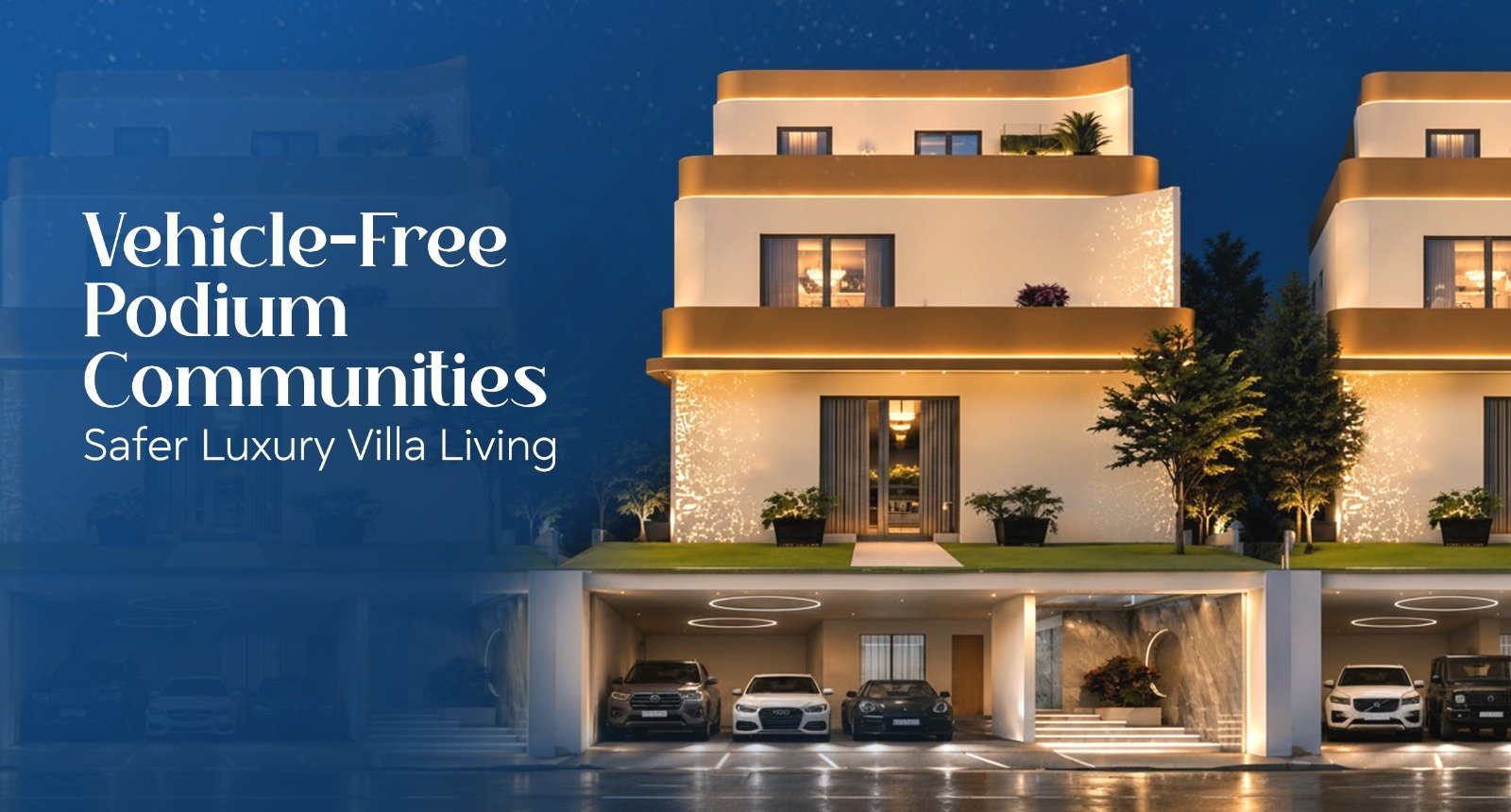
Most gated communities in Hyderabad solve one problem: controlled entry. A boom barrier, a security desk, and a perimeter wall. What they don’t solve is what happens once you’re inside the gate, where residents, children, staff, and delivery vehicles all share the same internal roads. Podium communities remove that shared space entirely, and that difference matters more than it might first appear.
What Makes a Community “Vehicle-Free”
A vehicle-free podium community keeps all car movement, parking, and service traffic at a lower level, while the entire pedestrian layer above, walkways, gardens, villa entrances, and common spaces, has no vehicle access at all. This is different from a standard gated villa community, where the gate controls who enters, but cars still travel the same internal roads that residents and children walk on daily.
The distinction is worth being precise about, because “gated community” and “vehicle-free community” solve different problems. Gating controls who gets in. Vehicle-free design controls what happens once they’re in.
Why This Changes Daily Safety, Not Just Perception
In a conventional gated villa community, the risks that come with shared roads don’t disappear just because the community is private. Cars still reverse out of driveways. Delivery and service vehicles still move through internal lanes. Children playing near the street still share that space with moving traffic, just behind a gate instead of on a public road.
Removing vehicles from the pedestrian layer entirely eliminates that specific risk category rather than reducing it. A child walking to a neighbour’s villa, a resident on an evening walk, or staff moving between homes never has to account for a car in their path within the community. This is a structural safety difference, not a design preference.
Beyond Safety: What Else Changes
- 1. Quieter common spaces. Engine noise, reversing beeps, and idling vehicles stay at the parking level, so gardens and walkways stay genuinely quiet.
- 2. Better air quality outdoors. Exhaust doesn’t collect at the level where residents actually spend time.
- 3. Uninterrupted landscaping. Without rows of parked cars along internal roads, open spaces read as open, not broken up by vehicles.
- 4. More usable common areas. Space that would otherwise go to internal roads and driveways can be designed as gardens, courtyards, or walking paths instead.
- 5. Cleaner arrival experience for guests. Visitors park at the lower level and walk into a community with no vehicles in view, rather than navigating past parked cars to reach a villa entrance.
How This Differs From a Standard Gated Community
A standard gated villa community controls access at the perimeter but keeps conventional road layouts, driveways, internal streets, and parking along the road. A podium-based vehicle-free community applies that same access control at the gate, then goes further by separating vehicle movement from the pedestrian layer at the design stage, not just at the entrance.
This is a meaningful distinction to check for when comparing gated community villas in Hyderabad. Many projects market themselves as “gated” or “secure”, which is accurate but only addresses perimeter control. Fewer address what happens inside the gate once vehicles and pedestrians share the same space.
What to Look For When Comparing Communities
- 1. Does the internal layout have any shared roads where cars and pedestrians cross paths, or is the separation complete?
- 2. Are children’s play areas, gardens, and walkways adjacent to internal roads or fully removed from vehicle routes?
- 3. Is visitor and delivery parking handled at a separate level, or do those vehicles still enter the residential layer?
Bridge Epsilon in Tukkuguda applies this at the community level across all 128 villas. Vehicle movement, resident and visitor parking, and service access stay entirely at the ground floor, while the elevated podium above carries walkways, gardens, and villa entrances with no vehicle access. For more on how the parking and structural design are behind this work, see our guide on podium parking explained.
Conclusion
If safety and daily liveability are priorities in your search, it’s worth asking any shortlisted project directly whether vehicles and pedestrians share internal roads or are fully separated. You can download the Bridge Epsilon floor plans or schedule a site visit to see the layout firsthand.
FAQs
1. Is a vehicle-free community actually safer for elderly residents, not just children?
Yes, the same structural benefit applies. Removing vehicle movement from walkways and community paths reduces fall and collision risk for elderly residents on daily walks, not just for children at play, since no one in the pedestrian layer has to account for moving traffic.
2. How does household staff, like maids or drivers, move around if cars can’t enter the pedestrian layer?
Staff move on foot via the same pedestrian pathways as residents once vehicles are parked at the ground level. Drivers park in the designated parking deck and access villas through pedestrian connection points; ask the sales team for the specific staff-movement layout at Bridge Epsilon.
3. Is a vehicle-free podium community the same as a “gated” community?
No, and this is a common point of confusion. Gating controls who enters at the perimeter; vehicle-free podium design controls what happens once they’re inside by removing vehicle movement from the pedestrian layer entirely. A community can be gated without being vehicle-free.
4. Does removing vehicles from the community layer affect visitor drop-off convenience?
Visitors park at the ground-floor level and walk up to the podium deck rather than driving directly to a villa entrance. This adds a short walk compared to conventional gated villas but removes vehicle traffic from the areas residents use daily; weigh this trade-off based on your own priorities.
5. Does a vehicle-free design genuinely support better resale value, or is that just marketing?
There isn’t enough transaction history on vehicle-free podium villas specifically to make a firm resale claim, and Bridge Epsilon doesn’t have completed resale data yet given the project’s stage. Treat safety and design differentiation as a lifestyle benefit first, and confirm resale expectations with the sales team rather than assuming a premium.